Sweet and Spicy Meal Prep Breakfast Bowls

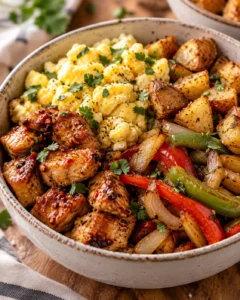
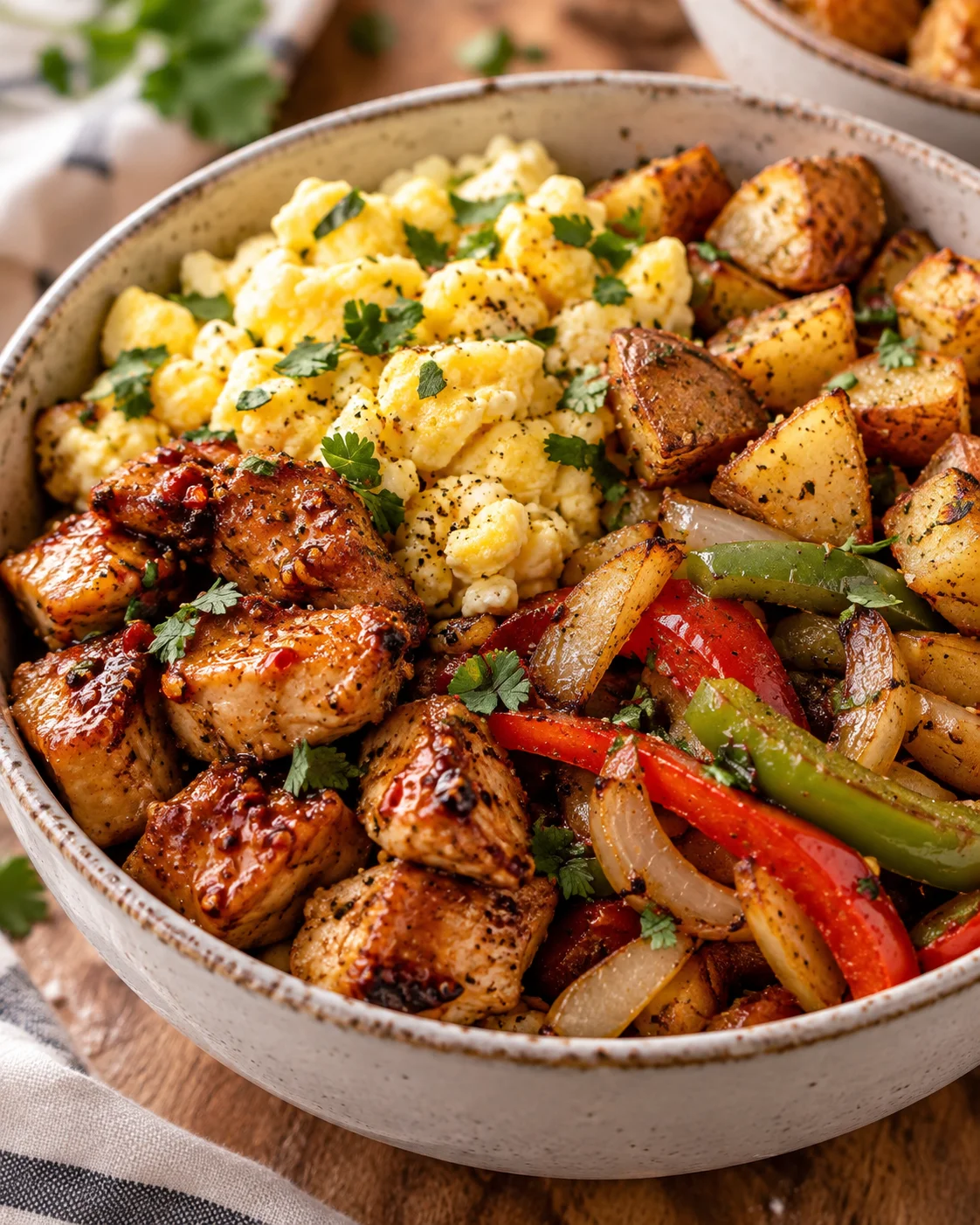
These meal prep breakfast bowls combine sweet-and-spicy chipotle pineapple chicken, softly scrambled eggs, and a generous sheet pan of roasted potatoes, bell peppers, and onion. With 42 grams of protein per serving, they are substantial enough for a busy morning. The Tex-Mex flavors land somewhere between a breakfast scramble and a chorizo-and-potato egg taco: savory, gently sweet, smoky, and easy to finish with your favorite salsa.
The full recipe makes eight bowls, so it works equally well for feeding a group or stocking the freezer with ready-to-reheat breakfasts. Each serving contains 6 ounces of cooked chicken, 4 ounces of scrambled eggs, and 4 ounces of roasted vegetables. That adds up to 465 calories, 42 grams of protein, 31 grams of carbohydrates, 17 grams of fat, and 4 grams of fiber per bowl.
There are three simple components, and each can be prepared while another cooks. Start the potatoes in the oven, brown the ground chicken and blend its sauce, then scramble the eggs while the vegetables finish roasting and the chicken simmers. Dividing the work this way keeps the full one-hour recipe practical even though it produces eight substantial breakfasts.
Why You Will Love These Breakfast Bowls
- They are built for meal prep. Eight servings give you enough to feed a crew, refrigerate several breakfasts, or freeze individual portions for later.
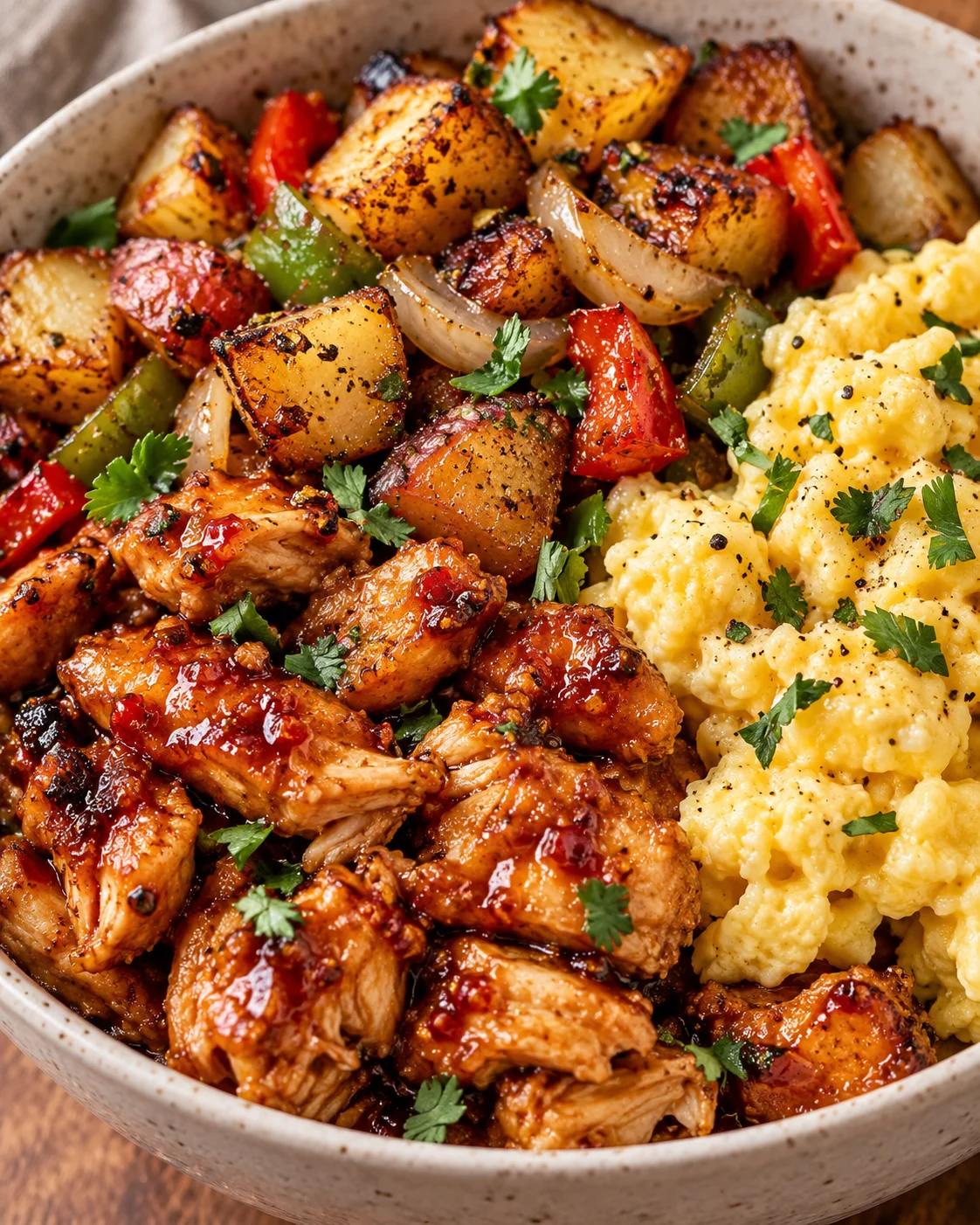
- Every bowl has contrast. Tender potatoes and lightly browned peppers and onions sit beside soft eggs and saucy chicken crumbles. The pineapple balances the heat of the chipotle peppers without turning the chicken into a dessert-sweet filling.
- The portions are clear. For eight even bowls, use 6 ounces of cooked chicken, 4 ounces of scrambled eggs, and 4 ounces of roasted vegetables in each container.
- The components are flexible. You can use ground turkey in place of ground chicken, use a mixture of whole eggs and liquid egg whites, or explore the supplied vegetable and seasoning alternatives without changing the core preparation.
- The recipe fits a real morning. Once the bowls are assembled, refrigerated portions only need reheating. Frozen portions can thaw in the refrigerator overnight before going into the microwave in the morning.
The eight-serving split also creates a balanced ratio of chicken, eggs, and vegetables. If you divide the batch into a different number of portions, use the component nutrition figures in the FAQ to calculate the arrangement that makes sense for your needs rather than guessing from the per-bowl values.
Ingredients and Notes
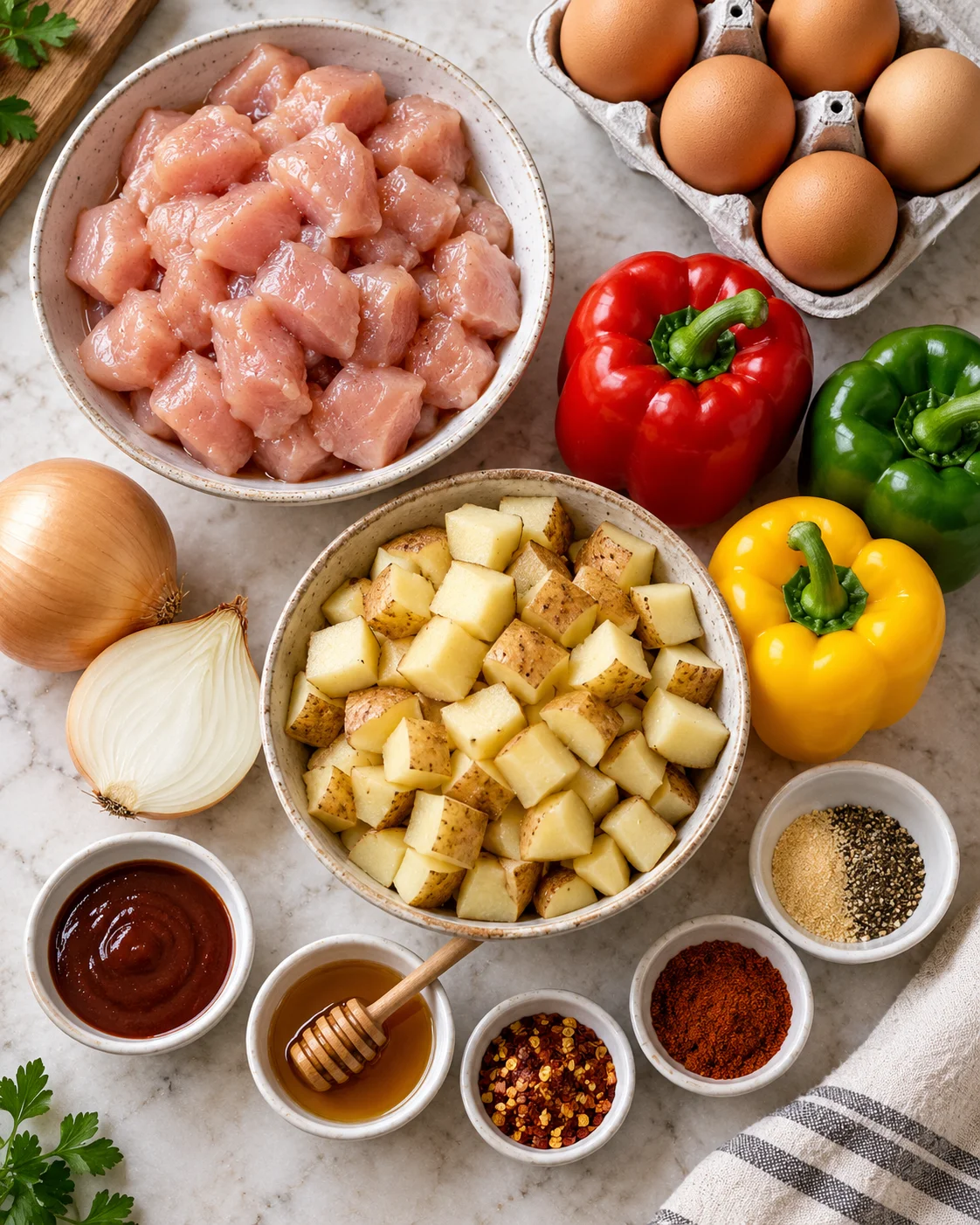
The ingredient list is divided into vegetables, chicken, and eggs so you can set up each component without overlooking anything. The chicken sauce is especially efficient: the canned pineapple, chipotles, garlic, salt, oregano, and warm spices all go into the food processor together.
For the roasted vegetables
- 24 ounces baby gold potatoes, quartered: Quartering keeps the pieces small enough to become fork-tender during the stated roasting time.
- 4 bell peppers, medium diced: A medium dice helps the peppers roast alongside the onion without disappearing into the pan.
- 1 yellow onion, medium diced: Keep the onion pieces similar in size to the peppers for more even browning.
- 2 tablespoons (32 grams) olive oil, divided: One tablespoon coats the potatoes, and the other coats the peppers and onion.
- 1/2 teaspoon garlic powder: This seasons the peppers and onions before they join the potatoes.
- Salt and pepper, to taste: Season the potatoes first, then season the pepper-and-onion mixture separately.
For the sweet and spicy chicken
- 2 pounds ground chicken: Extra-lean ground chicken breast was used for the supplied chicken nutrition figures. Ground turkey also works when ground chicken is unavailable. You can also make ground chicken breast in a food processor if your store does not carry it.
- 1 (20-ounce) can pineapple in 100% juice: Use the pineapple and juice in the blended sauce. It provides sweetness to balance the chipotle heat.
- 1 (4-ounce) can chipotle peppers in adobo: These bring smoky chile flavor and heat to the sauce.
- 4 cloves garlic: Blend them directly into the sauce.
- 1 teaspoon kosher salt
- 1 teaspoon ground cumin
- 1 teaspoon dried oregano
- 1/2 teaspoon ground cinnamon
- 1/4 teaspoon ground cloves
The cumin and oregano keep the sauce savory, while the small amounts of cinnamon and cloves round out the chile and pineapple. The sauce resembles an al-pastor-inspired combination but does not use achiote paste. Keep all of the listed seasonings in the blend so the sauce retains its intended sweet, smoky, and warmly spiced profile.
For the scrambled eggs
- 18 large eggs, slightly beaten: A large pan makes this quantity easier to manage. If a full carton feels unwieldy, scramble the eggs in two or three batches.
- Cooking spray, oil, or butter: Use enough to coat the nonstick skillet before scrambling.
How to Make Meal Prep Breakfast Bowls
Plan for 15 minutes of preparation and 45 minutes of cooking, or 1 hour total. The potatoes need a head start, so follow the sequence below instead of placing every vegetable on the pan at once.
- Preheat the oven. Set the oven to 450ºF. If you want easier cleanup, line a half sheet pan with parchment paper; the lining is optional.
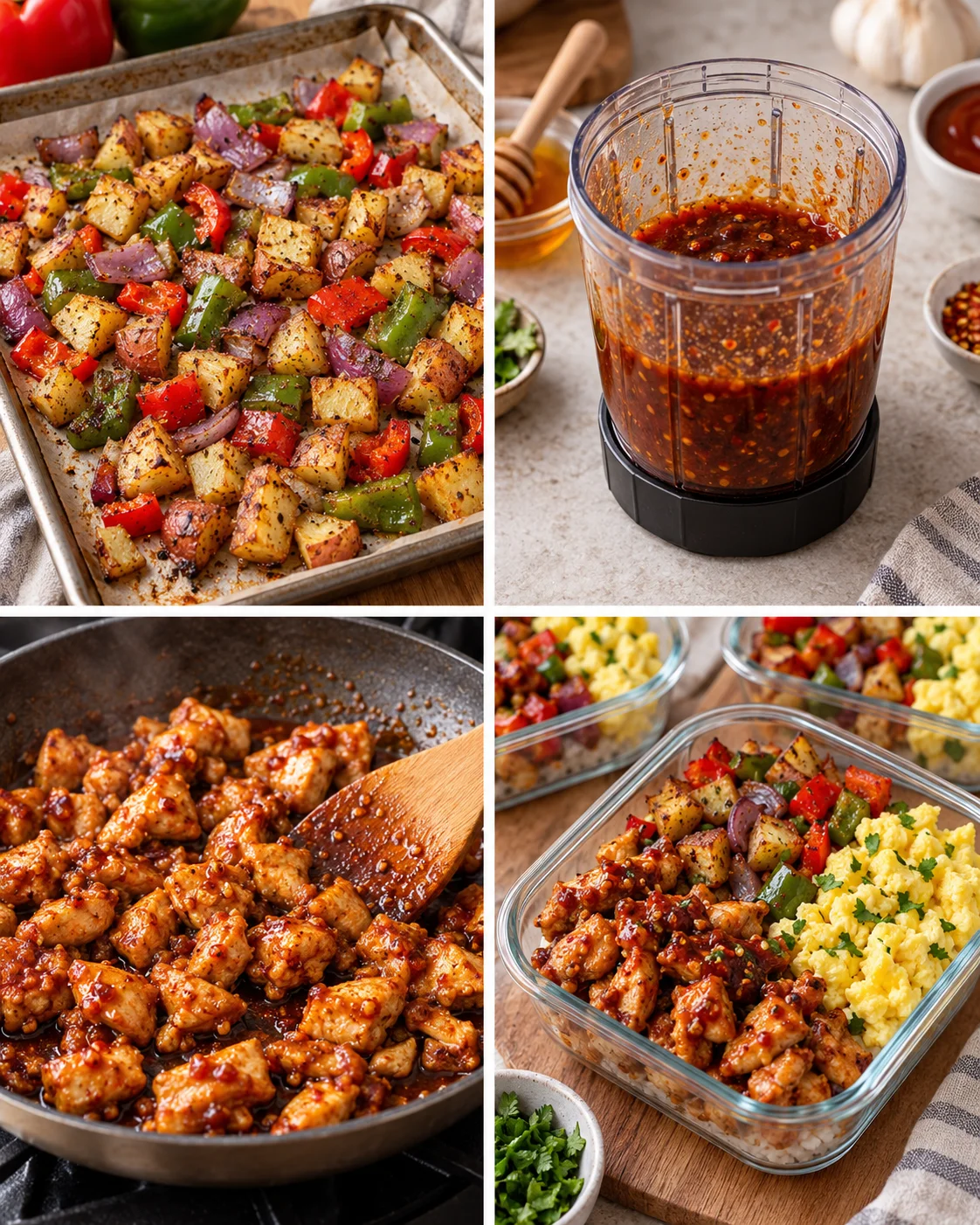
- Begin roasting the potatoes. Put the quartered baby gold potatoes on the sheet pan. Add 1 tablespoon of the olive oil and a pinch each of salt and pepper, then toss until the pieces are coated. Spread them over the pan and bake for 15 minutes.
- Season the peppers and onion. While the potatoes roast, combine the medium-diced bell peppers and yellow onion with the remaining 1 tablespoon olive oil. Add the 1/2 teaspoon garlic powder and another pinch each of salt and pepper, then toss well.
- Add the remaining vegetables. After the potatoes have roasted for 15 minutes, add the seasoned peppers and onion to the same sheet pan. Toss everything together so the vegetables are distributed across the pan.
- Finish roasting. Return the sheet pan to the oven for another 25 to 30 minutes. The potatoes should be fork-tender, and all the vegetables should show light browning around their edges.
- Brown the chicken. While the vegetables roast, heat a large skillet over medium-high heat. Add the ground chicken and leave the first side to brown for 3 to 4 minutes before breaking it apart. Continue cooking until the chicken is fully cooked.
- Blend the pineapple-chipotle sauce. As the chicken cooks, add the canned pineapple in 100% juice, chipotle peppers in adobo, garlic, kosher salt, cumin, oregano, cinnamon, and cloves to a food processor. Blend for 2 to 3 minutes, until the sauce is smooth.
- Simmer the chicken. Once the ground chicken is fully cooked, pour the blended sauce into the skillet. Bring it to a simmer, reduce the heat to low, and let it continue simmering while you prepare the eggs and wait for the vegetables. Stir occasionally so the crumbles remain evenly coated.
- Scramble the eggs. Coat a nonstick skillet with cooking spray, oil, or butter and warm it over medium-low heat. Add the slightly beaten eggs and cook, stirring to scramble, until they are set. Keep the heat below medium and be patient. If your skillet cannot comfortably hold all 18 eggs, cook them in two or three batches instead of crowding the pan.
- Build eight bowls. Divide the finished components into eight portions. Add 6 ounces cooked chicken, 4 ounces scrambled eggs, and 4 ounces roasted vegetables to each bowl. Add garnishes now only if they reheat well, or store cool, creamy, cheesy, and fresh toppings separately.
Tips for Success
Give the potatoes their full head start
Potatoes are denser than peppers and onions, which is why they roast alone for the first 15 minutes. Adding all three vegetables at the beginning could leave the peppers and onion overly soft before the potatoes become tender. Once everything shares the pan, use both cues in the recipe: the potatoes should yield to a fork, and the vegetables should be beginning to brown at the edges.
Use enough room for the eggs
Eighteen eggs are a lot for one skillet. A large pan gives you room to move the cooked curds aside as the remaining liquid egg sets. If the pan looks crowded, use two or three batches. That small extra step is easier than trying to control an overfilled skillet. Keep the burner at medium-low or otherwise below medium; high heat can race ahead before you have time to stir such a large amount evenly.
Fully cook the chicken before adding the sauce
The chicken should be browned and fully cooked before the blended pineapple-chipotle mixture goes into the skillet. Letting the first side cook undisturbed for 3 to 4 minutes develops browning before you break the meat into crumbles. After the sauce is added, bring it to a simmer and then lower the heat. The gentle simmer keeps the sauce working around the crumbles while you finish the eggs and vegetables.
Keep the assembly consistent
A kitchen scale makes the eight-bowl split straightforward: 6 ounces chicken, 4 ounces eggs, and 4 ounces vegetables per container. If exact matching portions are not important to you, divide each component visually into eight groups. Either way, distribute all three components before topping off any single bowl, so one generous early portion does not leave the final container short.
Store the toppings on their own
Prepare any toppings and garnishes for the batch at one time, but keep them in separate containers. This prevents hot sauce, salsa macha, cotija, Greek yogurt, sour cream, and fresh cilantro from being repeatedly heated with the bowls. Most of those options require little or no preparation, so the separate-topping approach adds flexibility without adding much work.
Variations and Substitutions
Ground turkey
Ground turkey can stand in for ground chicken in the savory component. Cook it using the same overall sequence: brown it, make sure it is fully cooked, then add the blended sauce and simmer. If you want chicken but cannot buy it already ground, ground chicken breast can be made in a food processor.
Whole eggs and egg whites
For a lower-fat egg component, use 9 whole eggs plus 1 1/2 cups liquid egg whites instead of 18 whole eggs. The supplied totals for that entire egg mixture are 845 calories, 97 grams of protein, and 43 grams of fat. By comparison, 18 whole eggs have about 1,290 calories, 113 grams of protein, 0 grams of carbohydrates, and 86 grams of fat. Because changing the eggs also changes each completed bowl’s totals, use the component figures rather than the original 465-calorie per-serving nutrition when making that version.
Other vegetables
For a lower-carbohydrate direction, the potatoes can be replaced with red radishes or a keto-style potato alternative. Radishes will not taste exactly like potatoes, but they pair well with the peppers and onion. Other suggested combinations include carrots, mushrooms, peppers, and spinach, or frozen hash browns with fajita vegetables. These options have different moisture levels, yields, and cooking needs, so monitor tenderness and browning rather than assuming every substitute will match the original roasting schedule exactly.
Air-fryer vegetables
An air-fryer version can use 24 ounces of potatoes and 2 peppers at 400ºF for about 30 minutes, shaking the basket about every 10 minutes. This method produces a lower vegetable yield than the full sheet-pan recipe. If you use it for the bowls, reduce the amount of chicken and eggs accordingly so the component ratio remains sensible.
Stovetop, one-skillet direction
For a stovetop approach inspired by a Mexican breakfast skillet, cook a chorizo-style protein first and transfer it out of the pan. Cook diced potatoes and poblano peppers in the covered skillet for 6 to 8 minutes. Once the potatoes are tender, move them to a bowl with the cooked protein and prepare egg whites in the same skillet. Return everything to the pan, top with chopped corn tortillas and cheese, and broil to finish. This is an alternative format rather than the exact sheet-pan bowl method, and it also makes a lower vegetable yield. Reduce the chicken and eggs accordingly if you borrow this approach for meal prep.
Different chicken seasoning profiles
The pineapple-chipotle sauce is the sweet-and-spicy choice used in the main recipe, but the ground chicken can take several other directions. Chorizo-style seasoning reinforces the taco-shop breakfast profile. Chicken tinga sauce moves toward tomato and chile flavors. A classic breakfast-sausage combination can feature black pepper, with a maple-and-black-pepper profile pairing especially well with roasted sweet potatoes. For classic breakfast sausage seasoning, add it to crumbled ground chicken rather than shaping patties. A prepared grocery-store simmer or skillet sauce is another minimal-effort option; select one that suits your preferred flavor and use it as the sauce for fully cooked crumbles.
Storage, Make-Ahead, and Freezing
Refrigerate assembled breakfast bowls for up to 3 to 4 days. If you are preparing more bowls than you will eat within that window, freeze the extras rather than extending the refrigerator time. Portioning them before storage means you can thaw and reheat only what you need.
For a frozen breakfast, transfer one bowl from the freezer to the refrigerator the night before. Microwave it for 3 to 4 minutes in the morning. Reheating appliances and portion temperatures can vary, so stir or rearrange the components as useful and make sure the food is hot before serving.
The recipe is naturally suited to parallel make-ahead work. Roast the vegetables, simmer the chicken, and scramble the eggs, then assemble the bowls. Store garnishes separately. Fresh cilantro, cotija cheese, hot sauce, salsa macha, nonfat Greek yogurt, sour cream, and warmed tortillas are better treated as finishing choices instead of being frozen and microwaved with every bowl.
Serving Suggestions
Serve each bowl with fresh cilantro, crumbled cotija cheese, hot sauce or salsa macha, nonfat Greek yogurt or sour cream, warmed tortillas, or any combination of those garnishes and sides. Salsa adds brightness and heat; cotija supplies a salty finish; and yogurt or sour cream gives the smoky chipotle sauce a cool, creamy counterpoint. Warm tortillas make it easy to scoop up the eggs, chicken, and vegetables together.
The finished bowl should have several distinct textures rather than one uniform scramble: saucy chicken crumbles, tender eggs, fork-tender potatoes, and peppers and onions with light browning around the edges. Keep toppings separate until serving if you want the roasted vegetables and garnishes to retain their character after storage.
Frequently Asked Questions
How many bowls does this recipe make?
It makes 8 breakfast bowls. For the stated portions, each bowl gets 6 ounces of cooked chicken, 4 ounces of scrambled eggs, and 4 ounces of roasted vegetables. You may divide the recipe differently, but doing so changes the nutrition per serving.
What are the nutrition facts for one bowl?
At the eight-serving portion above, one bowl has 465 calories, 31 grams of carbohydrates, 42 grams of protein, 17 grams of fat, and 4 grams of fiber.
What are the nutrition totals for each component?
The chicken component on its own has 1,455 calories, 197 grams of protein, 88 grams of carbohydrates, 24 grams of fat, and 16 grams of fiber; those figures use extra-lean ground chicken breast. The 18 large eggs have about 1,290 calories, 113 grams of protein, 0 grams of carbohydrates, and 86 grams of fat. The roasted vegetables have 965 calories, 22 grams of protein, 159 grams of carbohydrates, 29 grams of fat, and 19 grams of fiber.
Can I scramble 18 eggs at one time?
Yes, if you have a large pan and keep the heat at medium-low. If the quantity feels difficult to control, divide the eggs into two or three batches. Patience and lower heat make the process more manageable than trying to rush the entire carton over high heat.
Can I cook the vegetables without the oven?
Yes, but the supplied alternatives do not produce as many vegetables as the sheet-pan method. For the air fryer, use 24 ounces of potatoes and 2 peppers at 400ºF for about 30 minutes, shaking every 10 minutes or so. The stovetop direction uses covered diced potatoes and poblano peppers for 6 to 8 minutes before the remaining skillet components are assembled and broiled. Reduce the chicken and eggs accordingly when the vegetable yield is lower.
How long do meal prep breakfast bowls keep?
Keep them refrigerated for up to 3 to 4 days, then rely on the freezer for longer storage. Move a frozen bowl to the refrigerator the night before you plan to eat it, and microwave it for 3 to 4 minutes in the morning. Store toppings and garnishes separately so you can add them after reheating.
Nutrition
Serving: 6 ounces chicken, 4 ounces eggs, and 4 ounces vegetables; Calories: 465 kcal; Carbohydrates: 31 g; Protein: 42 g; Fat: 17 g; Fiber: 4 g.